Wednesday, May 20, 2009

Μεγάλοι Έλληνες

Παρακολούθησα με ιδιαίτερο ενδιαφέρον και θαυμασμό το τελικό των Μεγάλων Ελλήνων στην τηλεόραση του Σκαϊ στις 18 Μαΐου 2009. Το μορφωτικό και διανοητικό επίπεδο των συμμετεχόντων υψηλότατο και εντυπωσιακό. Παρόλο που επρόκειτο για μία άσκηση επί χαρτού ο ενθουσιασμός και το πάθος από τους παραβρισκόμενους να στηρίξουν με εμμονή την επιλογή τους ήταν διάχυτος και βαθύτατα ειλικρινής. Και διερωτώμαι σε αυτό το σημείο πού είναι αυτό το πάθος στην αντιμετώπιση της μίζερης πραγματικότητα μας; Σκεφτόμουν παρακολουθώντας την εκπομπή ότι αξίζουμε μία καλύτερη μοίρα από την γκρίζα, άοσμη, μπανάλ εποχή μας. Σκεφτόμουν ότι οι δέκα μεγάλοι έλληνες του τελικού, όπως πολλοί άλλοι στην λίστα των υπολοίπων ενενήντα, αποδεικνύουν και αναδεικνύουν ταυτόχρονα τις δυνατότητες μας ως λαός (ατομικά και συλλογικά), να συσπειρωθούμε και να κάνουμε την υπέρβαση. 

Το ερώτημα που τίθεται είναι πως η πνευματικότητα που εξέπεμπαν τόσο οι «αληθινοί» πρωταγωνιστές όσο και οι παρουσιαστές της εκπομπής μπορεί τελικά να ενθαρρύνει και να κινητοποιήσει τη θετική μας πλευρά – την δημιουργικότητα, την εργατικότητα, την ουσία – ώστε να επέλθει η απαραίτητη ανατροπή και να αφήσουμε την μιζέρια στο λυκόφως της ιστορίας; Αυτή η παθιασμένη και φορτισμένη ανταλλαγή απόψεών και γνώσεων μεταξύ αξιοσέβαστων ελλήνων μπορεί να εκφραστεί και να αναδειχθεί τελικώς και εκτός τηλεόρασης; Ή απλώς την Δευτέρα ζήσαμε ένα παραμύθι που δεν έχει καμία σχέση με την μετριότητα των ελλήνων σήμερα; Την Δευτέρα το βράδυ άρχισα να πιστεύω ξανά στο ελληνικό «φως», αλλά όταν τελείωσε η εκπομπή επανήλθε δριμύτατα το σκοτάδι. Μήπως αυτό που ένιωσα κατά τη διάρκεια της εκπομπής δεν ήταν τίποτα άλλο τελικά παρά μια μοναχική και μοναδική στιγμή αναλαμπής και υπέρβασης; Ελπίζω πως όχι διότι ένας λαός θαμπωμένος μόνο με το παρελθόν του είναι ένας λαός χωρίς μέλλον. Θα ήθελα να πιστεύω ότι οι μεγάλοι έλληνες κρύβονται μέσα μας και περιμένουν να τους ανακαλύψουμε.

Sunday, May 17, 2009

The European Union and its Eastern Neighbourhood: Challenges and Prospects

  • In a recent European Commission on the Implementation of the European Neighbourhood Policy (ENP) in 2008, it is stated that the ENP is “a growing partnership based on mutual interdependence.” This is evermore necessary since 2008 has been a year of crises that have led to gridlock both in the South and the East. The August 2008 war between Russia and Georgia, the Israeli intervention in Gaza in December 2008/January 2009 and the Russia-Ukraine gas crisis of January 2009 coupled with the growing negative impact on growth, trade, and investment of the global financial and economic crisis are all indicative on the frailty of the EU’s neighbourhoods. 


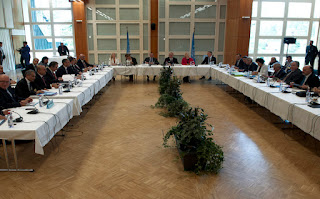
  • On 7 May 2009, the Prague Eastern Partnership Summit took place amidst great expectations from its promoters in an effort to further solidify/strengthen the bonds between the European Union and its member states and their Eastern European Partners (hereinafter ENP East partners – Ukraine, Moldova, Georgia, Armenia, Azerbaijan, Belarus). Though the Eastern Partnership (EaP) was conceived to bring the ENP East countries that so desire closer to the EU, to date it has fallen short of expectations because states like Ukraine, Georgia and Moldova have been hit by domestic dissent, spats with their neighbours and stalled modernisation processes. The fact that EU member states like Poland and the Czech Republic have so warmly sponsored the initiative may suggest ulterior motives in their approach toward their Eastern neighbourhood is very much in evidence.


  • The Russia factor is one that will not go away anytime soon as the parameters and content of future EU-Russia relations are currently being deliberated since June 2008 in the form of a new EU-Russia agreement replacing the Partnership and Co-operation Agreement concluded in 1994 and into force since 1 December 1997. At that time Russia was weaker and less self-confident than it is today. Albeit the Russian Federation’s adventurism in Georgia in August 2008 and its systematic attempts to prevent the further trespass of the European Union (and NATO) on its neighbourhood or near abroad, Russia’s economic ties with the EU and its role in energy security cannot be discounted.


  • When the European Neighbourhood Policy was first promoted in 2003, it attempted to address a number of emerging concerns for the European Union. The first had to do with the limits of enlargement given that big bang enlargement was about to become a reality in 2004. As such the ENP was conceived as a policy aimed at curbing further membership – an “anything but membership” policy where it made sense to group southern and eastern neighbour states together. As such bilateral action plans were promoted allowing southern and eastern partners to enhance their relations with the EU at their own pace. The second concern stemmed from the repercussions of the post-Cold War world with the emergence of new forms of global terrorism and ethno-nationalist secessionist movements becoming the fad in the wider post-Communist space (former Yugoslavia and former Soviet Union) with McMafia type transnational crime, weak state institutions and rule of law in abundance.


  • The European Security Strategy of December 2003 very much reflected these concerns. It stated explicitly, the EU has the strategic objective to ‘make a particular contribution to stability and good governance in our immediate neighbourhood [and] to promote a ring of well governed countries to the East of the European Union and on the borders of the Mediterranean with whom we can enjoy close and cooperative relations.’ Furthermore, the European Union has acknowledged the shared common neighbourhood with Russia as a space where the ‘EU and Russia need to work together, as neighbours, on common concerns.’


  • The last point being that the non-polarising concept of a common neighbourhood where it is both in the interest of Russia and the EU to assure the neighbourhood’s stability, security and prosperity lest it become even more infested with the diseases the post-Cold War Pandora’s box had unleashed. In other words, the European Union as a postmodern soft power entity saw itself as promoting a concept which was non-threatening to its eastern neighbours.


  • For Russia, though, the notion of neighbourhood (its ‘CIS space’) has been based on preserving its ‘historical and spiritual heritage’ which was encroached upon by the West in the early 1990s when as the key successor state of the Soviet Union it went through dire political and economic upheaval. According to Russian Foreign Minister, Sergei Lavrov,


‘Not only Russia has privileged interests, first and foremost, in relations with our closest neighbors; they also have the same privileged interests in Russia. Failing to understand it and trying to destroy what rests on our combined objective history and on the interdependence and intertwining of our economies, infrastructures, cultures and humanitarian spheres of life means to go against history.’


  • As a consequence, for Russia, the EU’s neighbourhood policy and the Eastern Partnership among others are revisionist policies which strive to remove from Russian influence the post-Soviet space thereby the ‘voluntary or involuntary aim of such method is to preserve the dividing line in Europe and move it ever closer to the Russian border.’
  • The Black Sea region is a telling example of the challenges in EU-Russian relations since all ENP East partners except Belarus are considered by the EU to be part of it. For Russia, the wider Black Sea area is an important part of its foreign policy given that is constitutes part of Russia’s ‘near abroad’ and its relevance as an energy transit region. More specifically, Russia seeks to remain as one of the main stakeholders in the region “given the emergence of new strong regional (Turkey) and external actors (the US/NATO)”; it wants to counter and curb extremism, separatism and terrorism in the region; it wants to secure continuous energy, trade, civil and military communications “within and throughout the Black Sea and the [Bosporus] Straits”; and it seeks to prevent new dividing lines in the region including “the expansion of military coalitions which exclude Russia as a full member.”
  • At the same time, Russia is not convinced that the EU’s European Neighbourhood Policy could successfully contribute to making the shared neighbourhood more stable (an objective shared by Russia) as it does not effectively bar the road to further future EU enlargement. The analysis by Arkady Moshes is indicative:


Brussels cannot ignore a consolidated push of EU new member states to be more active on the eastern periphery. As long as it denies membership perspective for its neighbours, the policy of Wider Europe that it pursues, (however palliative it may look) nevertheless stimulates their search for alternatives to staying within the same geopolitical and geo-economic space as Russia. Moscow, in this situation, starts viewing the EU not so much as a partner, but rather as a systematic rival to its foreign policy goals in the Western NIS and the Caucasus; a revisionist power; and is instinctively inclined to get involved in a ‘zero-sum game’ type of relationship with the EU.’


  • Thus the notion of neighbourhood and how it is perceived by key stakeholders is a major conundrum. Does it enhance further cooperation or further division/competition? As the limits of the ENP became evident over time and the EU began to uncouple its neighbourhood policy with the evolution of the Union for the Mediterranean in the South and the Black Sea Synergy (BSS) policy in the East in 2007/2008, further dividing lines emerged. The BSS epitomises the concept of regional cooperation. It put the Black Sea region on the radar screen of the EU as a single distinct policy area (the accession of Bulgaria and Romania, both Black Sea states, on 1 January 2007 effectively contributed to this process). The BSS promoted the concept of regional cooperation between the EU and the region as well as between the states of the region. It also sought to work with regional institutions such as the BSEC (Organisation of the Black Sea Economic Cooperation) which had been in place since 1992 without EU direct involvement but with the participation of all regional stakeholders (including Russia and Turkey) thereby promoting a sense of regional and local ownership (something ENP South partners and Western Balkan states have strived for as well) of the process. Through its emphasis on sectoral cooperation (such as transport, environment, energy, trade inter alia), it also promoted the need for solid institutions, good governance principles, rule of law and accountability – in other words, it allowed in a non threatening manner concepts of Europeanisation to the region.


  • Yet hardly a year having past before the BSS was introduced to the world, the EU launched the Eastern Partnership (EaP), which paradoxically the EU-27 have committed to just as much as they did for the BSS, which seeks ever closer relations with the ENP East partners testing the limits of Russian discomfort and EU unity  while duplicating many of the priorities of the BSS.


  • As such today, the EU beset by its own institutional inabilities to move beyond the restrictions of the Nice Treaty, awaiting (some would say praying for) the ratification of the Lisbon Treaty and its implementation, amidst a full-blown global financial crisis (which can only imply a hardening of mental and economic borders) finds itself sending contradictory signals to its ENP East partners and strategic political and economic partner Russia because its member states have found it convenient to exploit the lack of leadership and direction by transforming their national prerogatives and priorities into European ones (much of the same it could be argued is in evidence in the Mediterranean). In fact, the new EU member states have increasingly divergent perspectives regarding further enlargement to the East.


  • Nevertheless, the reality that the EU has to have some sort of neighbourhood policy (however many adaptations it undergoes) and the symbiotic/interdependent nature of the relationship between Russia and the Union at least in the economic front coupled with the devastating impact of the global financial crisis is having on both neighbours implies that over the mid- to long-term there is much more that unites rather than divides the two sides. It is worth keeping in mind that the Union is Russia’s main trading partner accounting for over 52% of Russia’s main trade turnover and the main investor in Russia while 50% of Russian oil exports and 63% of its natural gas exports go to the EU. The challenge is to convert or at least spill over the economic interdependency into the political realm.


  • In order to advance though, the need for relevance and less policy confusion, more flexibility and pragmatism coupled with policy harmonisation, the avoidance of policy duplication and greater co-ownership is paramount. Otherwise, the strain on human and financial resources and objectives will only to greater policy disarray within the EU as well as fewer incentives and tools to effectively assure that the notion of a common neighbourhood is effectively promoted.

Bibliography

Alexandrova-Arbatova, Nadia. 2008. Regional Cooperation in the Black Sea Area in the Context of EU-Russia Relations, ICBSS Xenophon Paper, no. 5. Athens: ICBSS.

European Commission, Communication from the Commission to the Parliament and the Council on the Implementation of the European Neighbourhood Policy in 2008, COM (2009) 188/3, Brussels, 23 April 2009.

General Secretariat of the Council of the EU, Report on the Implementation of the European Security Strategy Providing Security in a Changing World, Brussels, 11 December 2008.

---------. A Secure Europe in a Better World – The European Security Strategy, Brussels, 12 December 2003.

Geoana, Mircea. “Why we mustn’t look at Eastern Europe as a single bloc,” Europe’s World, Spring 2009.

Glenny, Misha. 2008. McMafia: A Journey Through the Global Criminal Underworld. New York: Knopf.

Lavrov, Sergei. 2008. “Russian Foreign Policy and a New Quality of the Geopolitical Situation” in Diplomatic Yearbook 2008 (Moscow). http://www.ln.mid.ru/brp_4.nsf/e78a48070f128a7b43256999005bcbb3/19e7b14202191e4ac3257525003e5de7?OpenDocument

Moshes, Arkady. 2006. “Prospects For EU-Russia Foreign and Security Policy Cooperation”. The EU-Russia Review, No. 2: 22-27.

Tsantoulis, Tannis. “Black Sea Synergy and Eastern Partnership: Different Centres of Gravity, Complementarity or Confusing Signals?”. ICBSS Policy Brief no. 12, Athens, March 2009.

Wallace, Helen. 2009. “The European Union and its Neighbourhood: Time for a Rethink”. ELIAMEP Thesis, 4/2009, Athens, May 2009.

Yannis, Alexandros. “The European Union and the Black Sea Region: The New Eastern Frontiers and Europeanisation”. ICBSS Policy Brief no. 7, Athens, May 2008

Wednesday, March 11, 2009

Αθήνα, 11 Μαρτίου 2009, Αφιέρωμα στον Θεόδωρο Κουλουμπή

Βιβλιοπαρουσίαση του βιβλίου:

Δ. Τριανταφύλλου, Κ. Υφαντής, Ε. Χατζηβασιλειου (επιμ.) Διεθνείς Σχέσεις: Σύγχρονη θεματολογία και προσεγγίσεις – Αφιέρωμα στον Θεόδωρο Κουλουμπή (Αθήνα: Εκδόσεις Παπαζήση, 2008)

Σήμερα, ημέρα χρέους και ευθύνης, χαράς και αναγνώρισης προς το πρόσωπο του καθηγητή Θεόδωρου Κουλουμπή, ως εκπρόσωπος των τριών επιμελητών του τιμητικού τόμου - Διεθνείς Σχέσεις: Σύγχρονη θεματολογία και προσεγγίσεις – θα ήθελα να αναφερθώ εν τάχει στους λόγους που μας παρακίνησαν να ξεκινήσουμε αυτό το φιλόδοξο εγχείρημα.

Αυτό το βιβλίο, όπως θα έχετε ήδη διαπιστώσει, συνιστά ένα φόρο τιμής στον καθηγητή Θεόδωρο Κουλουμπή. Έστω και αν ένας τιμητικός τόμος είναι μία φτωχή απόπειρα να τιμηθεί ένας άνθρωπος σαν τον Θεόδωρο Κουλουμπή, το εν λόγω σύγγραμμα, πιστεύουμε, πως είναι τελικά ο πιο άμεσος και αποτελεσματικός τρόπος έκφρασης αγάπης και εκτίμησης προς το πρόσωπο ενός εκπαιδευτικού και διορατικού παρατηρητή των Διεθνών Σχέσεων που από τον επαναπατρισμό του στην Ελλάδα από τις Ηνωμένες Πολιτείες στις αρχές της δεκαετίας του 1980 συνέβαλλε –και συνεχίζει να συμβάλει έως και σήμερα – όσο κανείς άλλος στην αυτόνομη και γόνιμη ανάπτυξη της επιστήμης των Διεθνών Σχέσεων σε αυτή τη χώρα.

Πράγματι, η προσφορά του Θεόδωρου Κουλουμπή στα γράμματα είναι ανεκτίμητη και δύσκολα μπορεί κανείς να την αποτιμήσει. Το πλέον χαρακτηριστικό και απτό δείγμα της προσφοράς του μπορεί να το διαπιστώσει κανείς μελετώντας το κλασσικό –πλέον– βιβλίο του Εξουσία και δικαιοσύνη – ένα βιβλίο το όποιο χαίρει ευρύτερης αποδοχής τόσο στην διεθνή όσο και στην ελληνική ακαδημαϊκή κοινότητα. Να σημειωθεί μάλιστα, ότι ο Θεόδωρος Κουλουμπής, ακούραστος όπως πάντα, επανεξέδωσε πέρσι μια επικαιροποιημένη έκδοση του βιβλίου του. Φυσικά, δεν πρέπει να παραγνωρίζει κανείς τη συνεισφορά του επίσης στη μελέτη της ελληνικής εξωτερικής πολιτικής και στην ανάλυση των ελληνο-τουρκικών σχέσεων, μελέτες οι οποίες έτυχαν επίσης παρόμοιας υποδοχής.

Για τον Κώστα Υφαντή και τον Ευάνθη Χατζηβασιλείου, επιμελητές αυτού του έργου, που όπως πολλοί άλλοι είχαν το προνόμιο να το γνωρίσουν από κοντά, τόσο ως δάσκαλο όσο και ως συνάδελφο στο Πανεπιστήμιο Αθηνών, και για μένα που είχα την τιμή να συνεργαστώ μαζί του στο ΕΛΙΑΜΕΠ στο παρελθόν και τώρα πλέον στα πλαίσια του ελληνο-τουρκικού φόρουμ, ο Θεόδωρος Κουλουμπής υπήρξε φωτεινό παράδειγμα. Μας έχει επηρεάσει βαθειά και συνεχίζει να το πράττει με το ήθος του, την ανθρωπιά του, την προθυμία του να ακούσει την άποψη του «Άλλου» και φυσικά με τις πάντοτε αιχμηρές τοποθετήσεις του επί ζητημάτων που άπτονται του παγκόσμιου γίγνεσθαι και των κρίσιμων ζητημάτων της εξωτερικής πολιτικής. Και στους τρεις από μας, ο καθηγητής Κουλουμπής υπήρξε – και συνεχίζει να είναι – κοντά μας πάντα έτοιμος να ακούσει τις ανησυχίες και τους προβληματισμούς μας ως νεώτεροι μελετητές και εκπαιδευτικοί.

Για αυτόν τον λόγο, θεωρήσαμε ότι θα έπρεπε να δημιουργήσουμε ένα βιβλίο που κατά τη γνώμη μας θα μπορούσε να συνεισφέρει ουσιαστικά στην ελληνική βιβλιογραφία καλύπτοντας σημαντικά κενά. Αυτό που επιδιώξαμε εξαρχής ήταν να συγκεντρώσουμε τους πιο καταξιωμένους επιστήμονες του χώρου, συμπεριλαμβανομένων αυτών που διαπρέπουν στο εξωτερικό, και να ενσωματώσουμε τις πλέον σύγχρονες θεωρητικές εξελίξεις και τάσεις στον τομέα των διεθνών σχέσεων σε ένα βιβλίο. Το γεγονός ότι τόσοι πολλοί καταξιωμένοι συνάδελφοι, 36 για την ακρίβεια, που αντιπροσωπεύουν διαφορετικές γενεές μελετητών, αποδέχτηκαν με χαρά την πρόταση μας και συνέβαλαν ο καθένας ξεχωριστά και όλοι μαζί στην εκπόνηση αυτού του τόμου επιβεβαιώνει την αξία του Θεόδωρου Κουλουμπή και συνιστά παράλληλα την μεγαλύτερη ίσως επιβράβευση της συνολικής προσφοράς του στην πνευματική ζωή του τόπου. Ως γνωστόν, η αναγνώριση του έργου του από τους ομότεχνους του είναι αναμφίβολα και η σημαντικότερη.

Σε αυτό το σημείο θα ήθελα να επισημάνω, πως αυτή η επίπονη προσπάθεια, που διήρκεσε πάνω από δυόμιση έτη, δεν θα είχε έρθει εις πέρας χωρίς τη βοήθεια μερικών προσώπων που αξίζουν ιδιαίτερη αναφορά.

Κατ' αρχάς, θα θέλαμε να ευχαριστήσουμε τον φίλο και συνάδελφο μας Σωτήρη Ντάλη, διευθυντή της σειράς «Διεθνής και Ευρωπαϊκή Πολιτική» και τον εκδότη, τον αδικοχαμένο Βίκτωρα Παπαζήση για την θερμή υποστήριξη τους. Επίσης,  θα θέλαμε να ευχαριστήσουμε θερμά και την Όλγα Μπόρου, υποψήφια διδάκτορα Διεθνών Σχέσεων, για την ακούραστη υποστήριξη της στη συλλογή των άρθρων και συνολική επεξεργασία του βιβλίου. Πρέπει να αναγνωρίσουμε ότι χωρίς τη συνδρομή της Όλγας, το φιλόδοξο αυτό εγχείρημα ίσως να είχε παραμείνει ανεκπλήρωτο.

Τέλος, σε ένα πιο προσωπικό επίπεδο θα ήθελα να ευχαριστήσω τους γονείς μου, που βρίσκονται σήμερα σε αυτή την αίθουσα, που με έχουν διδάξει με την προσωπική τους στάση και ήθος πάντα να θυμάμαι, να σέβομαι και να αναγνωρίζω αυτούς που ενήργησαν και συνεχίζουν να ενεργούν ως πρότυπα και μέντορες μου συμβάλλοντας στην καλλιέργεια μου – άνθρωποι δηλαδή όπως ο Θεόδωρος Κουλουμπης. Τέτοιες στιγμές μου έρχονται στο μυαλό οι λέξεις του Milan Kundera: «Ο αέναος αγώνας του ατόμου ενάντια στην ισχύ είναι ο αέναος αγώνας της μνήμης έναντι της λήθης».

Ακριβώς όπως και ο Θεόδωρος Κουλουμπής αγωνίστηκε και συνεχίζει να αγωνίζεται για να διασφαλίσει ότι η επιστήμη των Διεθνών Σχέσεων έχει στέρεες βάσεις στον ελληνικό ακαδημαϊκό κόσμο και για να εμπνεύσει τους νεώτερους μελετητές να συνεχίσουν με αμείωτο ρυθμό και ένταση αυτόν τον αγώνα, είναι πρωταρχικό χρέος μας όχι μόνο να μην λησμονήσουμε, αλλά και να αναγνωρίσουμε το ρόλο, την αφοσίωση και την ανεκτίμητη προσφορά του.

Θεόδωρε Κουλουμπή, σε ευχαριστούμε. 

Wednesday, January 28, 2009

Engaging the Black Sea region - the time for action is now

The international order has entered into a new era. Barack Obama has taken formally the reigns of power in Washington, the dismantling of a number of Bush-era policies has begun and the expectations of hope across the globe take hold. Amidst an ongoing, evergrowing international financial and economic crisis (where estimates of negative growth globally for the first time since 1950 abound), and the realities of the aftermath of the killing fields of Gaza, Obama’s agenda is filled to the brim and bound to overflow.

The Black Sea region – a region encompassing the South Caucasus, Russia, Turkey, Ukraine and some of the European Union’s member states – will undoubtedly constitute a high priority region, not in the least due to the presence of Russia. The issues at hand are many, they are complex and they are challenging. They could augur instability as well as the potential for constructive, long-standing cooperation and stability. For one, an interesting challenge has to do with the sort of relationship that will emerge between Russia and the United States. Will the probable engagement of Russia by the Obama administration on a variety on longstanding global imperatives, elevate Russia to greater than regional power status as the Kremlin’s current leadership aspires? As a consequence, what will be the implications of this power shift on the Black Sea region as a whole?[1] How will another regional heavyweight like Turkey with aspirations for an ever greater regional and global role (participation in the G-20, role model as moderate Islamic country, Alliance for Civilizations co-chair, regional leader, etc.) react to greater Russian influence?

As things stand today, at least in the opinion of this analyst, some of the key issues are the following:

  1. Energy and energy security. The last act in the ongoing energy feud between Russia and Ukraine is a clear indicator of the importance of energy security for the region and its customers, especially the European Union. Oil and natural gas – together with their exploration, production, and transport – are commodities that flow across borders however tenuous these might be.
  2. The recent winter energy gridlock between the two aforementioned countries has also led to a more balanced, less ideological and subjective analysis regarding Russia and its role. In other words, the muckraking whether periodic, systematic or inherent regarding Russian and its current regime has given way to more realist analyses, especially in western media outlets and research centres regarding the foreign policy and role of the countries of the region. Concepts such as the inevitability of a “soft war” with Russia[2] have given way to concerns about the ability of Ukraine (and Georgia earlier last year) to be reliable partners. Nevertheless the prevailing vestiges of ideological or bloc divisions (whether these come from Moscow or Western capitals) remain a challenge.
  3. This shaken credibility in Ukraine and Georgia or to be more precise in their current leaderships to bring about the requisite transformation inspired by the Orange and Rose revolutions respectively has placed their eventual Euro-Atlantic integration on the back burner. The question remains as to whether this also implies the end of European integration for Ukraine in particular or a renewed effort to integrate based not on the undelivered promises of reform but on clear conditionality where a condition is cooperation with all its neighbours.
  4. The redefinition of US-Russian relations as previously mentioned could and would seriously define whether the region enhances cooperation or is further divided. The impact on the uneasy status quo between Turkey and Russia is an important dimension. Turkey recently felt the limits of overreach when it received a firm rebuke from some EU states when it attempted to link its support for the Nabucco pipeline to its EU accession talks.[3]
  5. The European Union’s role in the region to date leaves much to be desired. EU leadership is needed but is it feasible? The EU is involved in the region in a number of fronts – it launched the Black Sea Synergy in 2007 and the Eastern Partnership in 2008. Both are ambitious policies though somewhat contradictory policies calling for more engagement in the Union’s Eastern neighbourhood. The Union has deployed since October 2008 a monitoring mission in Georgia (EUMM) under the European security and defence policy. It was also actively involved in mediating the Russia-Ukraine gas dispute. Finally the EU adopted in December 2008 a report beefing up its European Security Strategy by giving prominence to issues such as energy security, the various protracted conflicts, human security and greater engagement with the EU’s neighbourhood. On the other hand, the lack of progress on the ratification of the Lisbon Treaty which would beef up the Union’s foreign policy prospects, the continued inability to achieve consensus regarding the status of Kosovo (and hence its implication for separatist region of the Caucasus and their recognition) place serious restraints on the Union’s ability to pull its weight in the region. For example, the inability to arrive on a modus vivendi with Russia on the development of their common neighbourhood continues to be a thorn for the EU.
  6. Finally, a number of issues that are down the list in terms of priorities will eventually make their way up to the surface and will need to be handled by all stakeholders concerned. One such concern has to do with the future of the Russian Black Sea Fleet once the lease on Sevastopol expires in 2017. Reports of the construction of a naval base in Abkhazia actually suggest that the issue needs to be dealt with sooner rather than later. Beyond the tricky issue of the Fleet’s future deployment, the economic impact of the withdrawal of the fleet on Sevastopol itself is a concern in itself. Ideas such as the one propounded by the city’s mayor that Sevastopol become a Free Economic Area merit consideration. Another possible flashpoint has to do with Crimea’s future.[4] Imaginative solutions that assure its future within Ukraine need further study.

In light of the aforementioned concerns, what needs to be done? Conceivably, the countries of the region have to constructively work together either bilaterally or regional within the framework of existing cooperative arrangements such as the BSEC and others. This continued cooperation which in the BSEC, for example, has survived the August 2008 Georgian-Russian war acts as a confidence building measure or mechanism for all stakeholders. In this context, the European Union in its capacity as an observer to the BSEC needs to assert itself that regional cooperation is part and parcel of successful engagement and ever closer ties with its ENP East partners. A lesson from both Georgia’s and Ukraine’s recent troubles with Russia is that attention needs to be paid to their neighbour(s) while they seek to integrate with the West. In other words, further integration into euro-atlantic structures need not imply the severing of relations with powerful neighbours that have no such aspirations. Regional cooperation helps states eventually move away from zero sum thinking and actions. In fact, the BSEC together with other regional initiatives should actually be seen as promoting economic cooperation as a source of security “on the basis of a paradigm of security that is linked to democracy, respect for human rights and good governance.”[5]

Hence, the question that remains is whether the European Union at 27 has the ability to lead and put to use the “smart power” paradigm which Hillary Clinton in her Senate confirmation recently expounded for her country.[6] The transformative experience of the European Union is a manifold process which is sorely needed in the region. At a time when the United States is putting its house in order and seeks to redefine its international relations; the Union is still coping to achieve coherence in its external action as the Lisbon Treaty escapes ratification.

The wider Black Sea region - part EU region and large part of its neighbourhood - seeks guidance, cooperative action and greater engagement by all stakeholders. Whether this is possible remains to be seen. For example, as was recently proposed at a conference on the Black Sea, the Russian proposal for a new Europe-wide security pact could be an opportunity for the EU to introduce and promote the notion of “overriding European interests” and include the dimensions of energy and energy security in the discussions on the shape of the new security framework. Simultaneously, the promotion of a set of commonly defined principles regarding energy and energy security in the BSEC or some other inclusive regional cooperation framework could also be another targeted action that engages all sates of the region and obliges key energy producing and transit states to work with their neighbours. The time for action is now.


[1] Incidentally, in a recent article by Henry Kissinger on what the new US administration ought to do in the international arena, Russia is not mentioned even once. See Henry Kissinger, “The chance for a new world order,” International Herald Tribune, 12 January 2009.

[2] See, in particular, Bruce P. Jackson, “The ‘Soft War’ for Europe’s East,” Policy Review, June-July 2006.

[3] On a visit to Brussels, Tayyip Erdogan, Turkey’s prime minister said on 19 January 2009 that "if we are faced with a situation where the energy chapter remains blocked, we would of course rethink our position [on Nabucco],". Reacting to Erdogan’s remarks, Germany’s Economy Minister, Michael Glos said that “Turkey is engaged in ‘political blackmail’. See “Turkey plays energy card in stalled EU accession talks,” EurActiv.com, 20 January 2009 andTurkey Blackmailing EU Over Gas Pipeline, German Minister Says,” dw-world.de, 20 January 2009.

[4] See, in particular, Merle Maigre, “Crimea – The Achilles’ Heel of Ukraine,” www.icds.ee, November 2008.

[5] See Felix Ciuta, “Region? Why Region? Security, Hermeneutics, and the Making of the Black Sea Region,” Geopolitics, 13:1, 2008.

[6] “We must use what has been called “smart power”: the full range of tools at our disposal -- diplomatic, economic, military, political, legal, and cultural -- picking the right tool, or combination of tools, for each situation. With smart power, diplomacy will be the vanguard of foreign policy.” Statement of Senator Hillary Rodham Clinton, nominee for Secretary of State, Senate Foreign Relations Committee, 13 January 2009.


Tuesday, January 6, 2009

Demolition Derby versus Pericles

Undeniably, the riots of December 2008 in Athens and elsewhere in Greece have made a return to normalcy extremely difficult. Yesterday, we heard that 31 shots with the intention to kill were fired against three policemen on guard duty with one in stable but critical condition after marathon surgery. The holiday season is over and trouble is about to break loose again. While I try to convince myself that the end of apathy and the audacity of hope are near, if not here, the continued downswing of my country where what seems to prevail is the violence of a tiny minority, where the authorities are at a loss as to how to (re)act, where the police do not know anymore how to act, where should the violence and destruction begin anew, fear will become all the more prevalent should the rock and Molotov throwers become the norm.

A demolition derby is in place, in full swing while we, most ordinary citizens, watch stupefied, irritated, apathetic at times and at a loss to react at others. I keep telling myself that the time to rebuild is here yet is this just wishful thinking on my part? Am I blinded by the incompetence that prevails, unable or not wanting to accept the reality that is my country? And in my perpetual inner turmoil the idea of flight becomes all the more prescient. Yet the need to resist, to contribute to changing the reality, to convert the downswing into an upswing is just as great, if not a more profound call.

In his Funeral Oration delivered in 431 BC, Pericles says:

Our form of government does not enter into rivalry with the institutions of others. Our government does not copy our neighbors', but is an example to them. It is true that we are called a democracy, for the administration is in the hands of the many and not of the few. But while there exists equal justice to all and alike in their private disputes, the claim of excellence is also recognized; and when a citizen is in any way distinguished, he is preferred to the public service, not as a matter of privilege, but as the reward of merit. Neither is poverty an obstacle, but a man may benefit his country whatever the obscurity of his condition. There is no exclusiveness in our public life, and in our private business we are not suspicious of one another, nor angry with our neighbor if he does what he likes; we do not put on sour looks at him which, though harmless, are not pleasant. While we are thus unconstrained in our private business, a spirit of reverence pervades our public acts; we are prevented from doing wrong by respect for the authorities and for the laws, having a particular regard to those which are ordained for the protection of the injured as well as those unwritten laws which bring upon the transgressor of them the reprobation of the general sentiment.” (http://www.wsu.edu/~dee/GREECE/PERICLES.HTM)

Am I and my fellow citizens not deserving of a political and social system described by Pericles? Wasn’t the return of Democracy in 1974 supposed to represent the return of Pericles’ enlightened democracy? Unfortunately, this is not the case.

Stay, fight, contribute, I tell myself. “Ask not what your country can do for you but what you can do for your country” is probably the most apt, accurate description of what is wrong with Greece and what needs to be done.

Clientelism and corruption have brought us to a great extent to the brick wall we seem unable to pull down. We have become demandeurs instead of participants in the political life of the country, accepting mediocrity in the shape of lifelong public sector jobs instead of contributing to the creation of a vibrant meritocracy with world class education, regional leadership, and the like. We have forgotten not only our heritage (sic. the attempts to put fire to the National Archaeological Museum and the National Library, to deface the University of Athens among other public and historic buildings, and to use the Acropolis for political sloganeering) but the fact that its values transcend our sovereign and temporal borders.

At a time when real GDP in the United States, Japan and the Euro-zone countries is in decline with fall in output and rising unemployment with the probable decline in global output growth for the first time since 1950, the street protests are indicative of a growing malaise among the young generations of rage, that the future is not as bright as it is meant to be. Paradoxically, as a result, necessary reform of education and social systems are put on hold as in this climate of anger, a proper understanding of what needs to be done is impossible. If one is to add the new tangible threat of climate change and the need to cope with it, the frustration grows.

And herein lies the fascination with the Greek case and the fears of its exportation elsewhere in Europe. The fact that the uprisings are taking place in Greece inspire historically knowledgeable Europeans in that much that is worth fighting for comes from Greece and the ideals it embodies – democracy, meritocracy, equal justice, equal opportunity, striving for the greater good of the community, and excellence in education or Paideia. The resistance to the military junta helped lead to its downfall in July 1974 especially when it acquired an international dimension based on defending democratic values. While other enlightened Europeans are inspired and concerned by the magnetic appeal of Greece and all it represents, here we have uncovered ourselves as deeply ahistorical and uninspiring – either struggling to maintain the clientelist political system in place or not to reform education and modernise society at all as if time has stood still since the return of democracy. This cannot remain the norm anymore. The demolition derby will continue as long as we refuse to listen to Pericles.

Tuesday, December 16, 2008

The End of Apathy, the Audacity of Hope

It is hard to put into words what has been happening in Greece since 6 December with the shooting of a 15 year old by a policeman who thought he is a combination of Rambo and Dirty Harry while forgetting that both celluloid heroes sought to protect the innocent. Although rage and a feeling of helplessness still make concentration and proper expression extremely difficult at this time, I cannot help thinking that maybe 6 December 2008 is as important a date for Greece as 23 July 1974, the day the military government in Greece collapsed and democracy was reinstalled with Konstantinos Karamanlis becoming Prime Minister a day later.

Since 1974, the country has fully reintegrated into NATO, joined the European Community/European Union in 1981, adopted the Euro, significantly contributed to the ‘europeanisation’ of its neighbourhood with Balkan states either having joined the EU or committed to join in the future and Turkey negotiating its candidacy, helped ensure the membership of Cyprus to the Union, hosted successfully the 2004 Olympic Games, etc. At the same time, basic socioeconomic indicators have improved the quality of life of its citizens with the country’s GDP per capita ranked 18th out of 180 countries according to the IMF, its Human Development Index ranked 24th out of 177 countries according to the UNDP, and its Worldwide Quality of Life Index ranked 22nd out of 111 countries according to the Economist, while annual growth has averaged over 4% between 2003 and 2007, among others. Yet malaise prevails.

Why? A closer look at some of the indicators could begin to provide some of the answers. For example, while official unemployment figures for September 2008 show that it stands at 7,4%, it is over 24% for the 15-24 age group and 10% for the 25-34 age group and twice as much for women than for men. This implies the need for major structural reforms of the economic and social system, in particular in the sectors of education, health and the public sector at large. Yet, reform has been an ongoing theme of all governments since 1974. Why have they failed? Vested interests have profited from chronic structural woes which the public at large seems to have accepted as part and parcel of their daily lives. The Economist may unfortunately be right when it suggests that “Life is tough for youngsters with energy and talent but no cash or connections.”

Yet, the malaise which is compounded by the world economic crisis is even deeper. Has the political system gone bankrupt? Since the return of democracy, Greece has been governed by two parties that were founded at the time – PASOK and New Democracy in September and October 1974 respectively.  While the two aforementioned parties are still the only ones that actually possess the wherewithal to rule the country with relatively reliable and mainstream party platforms committed to the further integration of Greece to the core of European integration, the fact that the choice is still one between a Karamanlis and a Papandreou while lesser political families continue to play key roles in both parties implies that many if not most feel that the political system is alien. The question is at the same time simple and harsh: at a time when a black person in the United States knows he can become President of his country, how many Greeks actually feel that they could become Prime Minister of their country or even aspire to it? The answer is unfortunately almost none. The problem is that the two parties that owe much of their support to clientelist policies leading to a bloated, dysfunctional public sector and requisite public debt which have reached their limits while the private sector is held hostage either to the lack of proper regulatory mechanisms, lack of competitiveness, or to crooked tax inspectors and the like. At the same time, no other credible alternative and inspiring political force exists while the two big parties seem at this stage unable to put their differences aside and do what needs to be done together.

As a result, on Tuesday, 9 December while riots were ongoing in different neighbourhoods in the centre of Athens, 65,000 Athenians were at the Olympic Stadium watching a Champions League game between Panathinaikos and Anorthosis as if the fires in Athens and elsewhere had nothing to do with them! While the rage among the youth is an expression of the need for change; others think that what is going on has nothing to do with them. Fortunately, the latter are wrong. The riots and continued protests have launched vigorous debates and discussions among an ever growing number of citizens that begin to understand that although safe in their middle class cocoons, apathy can only bring about further social, economic and political gridlock as well as more street violence. The audacity of hope, as Barack Obama suggests, will hopefully emerge from this painful process. The need for all to feel that the country, its citizens and its leaders can do better is paramount. Hopefully, 6 December 2008, in spite of its tragedy, marks a new beginning for all.

Sunday, November 16, 2008

The EU and its Eastern Neighborhood: Time for Coherence

Much discussion is underway these days regarding the best way the European Union can approach its eastern neighbours. As a result, and probably to be expected, much confusion abounds as EU member states are divided on how best to address the region.

Undoubtedly, Russia is its dual capacity as one of the Union’s most important partners and new neighbour is at the core of the debate given the on-off nature of EU-Russia talks on a new Partnership and Cooperation Agreement which has taken a turn for the worse after the Georgian-Russian conflict of August. Do the EU and Russia share the same objectives in managing their common neighbourhood or does the prospect of EU membership, however distant if at all possible it might be at this time, for some of the common neighbours put the two sides on a collision course? Perceptions are important here – the inability of some EU member states to overcome their genuine fears of Russia and therefore insist on EU and NATO membership for those outside hoping to get in coupled with Moscow’s propensity to have its say exclusively along its western periphery suggest that both sides consider the other as ‘revisionist’ and prone to a zero-sum game type of relationship.

Unfortunately, it looks like these perceptions are going to be with us for some time to come, albeit there is some hope that they be somewhat mitigated if good sense prevails. A first step would be to reduce the NATO rhetoric and refocus on a “More EU – Less NATO aspirations” approach. This in effect seems for the time being to be the trend especially since the Alliance’s Bucharest Summit last April, the August war in Georgia and the election of Barack Obama to the White House.

Step Two would necessitate the EU to find a balance between Russia’s projected force and the other countries’ willingness to cooperate further with the EU. The EU should acknowledge the European identity of the states of the region, and keep open the prospect of membership in the long term. This entails the formulation of an ENP+ that neither closes the door nor does it open it further to those countries that aspire to join the EU but allows for a further upgrade of their relations with the Union. Such a ‘European promise’ would help to reinforce the reform process in all the countries of the region including conceivably the unrecognised territories.

Which policy then is the best for the Union and its neighbours? The divisions among member states have led to policy confusion. As a result in response to its Eastern Neighbourhood, the EU has already launched a Black Sea Synergy Policy within the context of the European Neighbourhood Policy (ENP); it is considering an ‘Eastern Partnership’ policy while it is also trying to define the context or place for the Turkish proposal for a “Caucasus Stability and Cooperation Platform” while simultaneously attempting to upgrade its relationship, both working and contractual, with regional organisations such as the BSEC. All these initiatives which are usually led by a country or a group of countries could conceivably create new problems as they seem to be redundant, uncoordinated and lack coherence.

The current debate in Brussels about the adoption of an Eastern Partnership that focuses on deepening bilateral cooperation by offering more profound integration with the EU to the ENP East partners including Belarus seems to complicate somehow the formulation of a coherent policy as it contains many of the priorities of the Black Sea Synergy. If it is conceived as a parallel track to the Black Sea Synergy process, it should be explicitly made clear as should the interaction/complementarity between the two policies. When drafting a European policy for the Black Sea region, it is important to avoid any possible overlapping between these two policy proposals/documents that might create confusion and thus weaken the credibility and the efficiency of the EU itself.

One suggestion that this author is making would be to rename the Black Sea Synergy policy and call it Enhanced Black Sea Synergy whereby regional cooperation between all regional states (including Russia) and the EU coupled by deeper integration with the EU by the ENP East partners go hand in hand. Overall, there should be a formulation for a new EU regional policy on the Black Sea. In this context, an Eastern Partnership with clear objectives, Europeanising features, strong instruments and promising ‘carrots’ along with an enhanced, project-oriented Black Sea Synergy, is a good start. This could at least help avoid the confusion regarding policy proliferation, replication and incoherence. It should be noted, that the Black Sea Synergy should not be underestimated as it managed to raise from the very beginning the political identity of the region and thus paved the way for a more coherent EU approach towards the region as a whole. Sidelining it or eventually burying it in favour of, undoubtedly, an ‘in your face’ policy would not help improve the state of EU-Russian relations and, by extension, regional security and stability anytime soon.